Work record
At the Back of the North Wind
George MacDonaldAt the Back of the North Wind by George MacDonald (1871)Diamond sleeps in a hay-loft above the horse whose name his father has given him.1871 · 19th Century · Novel · English
Read this when a child's quiet kindness must stand beside the great questions carried by a storm.
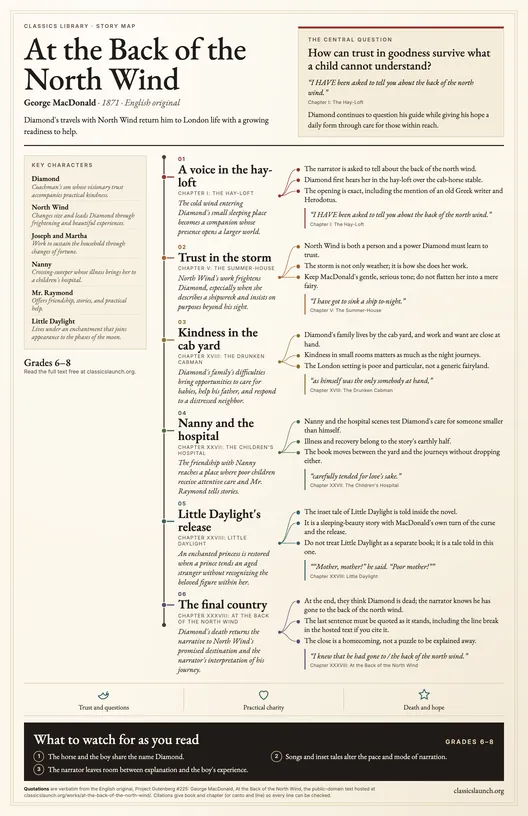 Story mapSee the story mapThe whole book on one page: the story in movements, the characters, and what to watch for. Free to print.
Abstract
Background. MacDonald's 1871 novel joins the streets and working households of Victorian London to an imaginative country beyond the north wind. The hosted text includes the whole book and the embedded story of Little Daylight. Its Christian interests emerge through dialogue, narrative patterns, and acts of care rather than a separate doctrinal argument.
Content. A coachman's son travels with a mysterious woman who changes size and seems to govern storms. Family reverses bring him into cab-yard life, where he assists adults and befriends children in need. Stories, songs, hospital visits, and improved circumstances lead toward a final departure understood differently by the household and the narrator.
Themes. The central inquiry concerns confidence in goodness when events exceed a child's understanding. Everyday service supplies a practical counterpart to visionary experience: feeding, comforting, working, and listening make trust active. The princess's tale further connects love with recognizing worth beneath altered appearances, offering a smaller narrative reflection of the novel's larger hope.
Significance. Neither the fantastic journeys nor the London scenes can be omitted without changing the book's character. Their alternation asks readers to consider how an unseen assurance might shape visible conduct. The conclusion remains emotionally serious while refusing to make bereavement the last word. Patient reading rewards attention to the narrator's limits, Diamond's questions, and the many forms of companionship.
Main characters
- Diamond: Coachman's son whose visionary trust accompanies practical kindness.
- North Wind: Changes size and leads Diamond through frightening and beautiful experiences.
- Joseph and Martha: Work to sustain the household through changes of fortune.
- Nanny: Crossing-sweeper whose illness brings her to a children's hospital.
- Mr. Raymond: Offers friendship, stories, and practical help.
- Little Daylight: Lives under an enchantment that joins appearance to the phases of the moon.
Summary
Diamond sleeps in a hay-loft above the horse whose name his father has given him. His family's world is modest and practical: horses need feeding, adults need employment, and cold air finds its way through old boards. Yet the wind outside becomes a woman who speaks to him. North Wind can be gentle enough to carry a child in her hair or immense enough to move across a city and sea. Diamond's journeys with her make the familiar world strange without removing its ordinary needs. Trust grows through questions. Diamond wants to believe North Wind is good, but some of her work appears frightening. Her announcement that she must sink a ship brings the difficulty into focus. She insists that her actions belong to purposes he cannot yet understand. The story does not turn this exchange into a simple explanation of every loss. Instead, Diamond's attachment to her and his glimpses of the country at her back become the center of an imaginative inquiry into death, goodness, and limited knowledge. Meanwhile his family loses its earlier security, and his father becomes a London cabman. Diamond helps at home, cares for babies, learns about driving, and brings his unusual cheerfulness into distressed households. He approaches a drunken neighbor when the man's wife and child need help. He befriends Nanny, a crossing-sweeper whose illness takes her into a children's hospital. Mr. Raymond provides another kind of companionship through stories, practical kindness, and later help for the family. The inset tale of Little Daylight gives the book's larger concerns another form. A princess's enchanted condition changes with the moon, and a prince's compassionate care for an apparently aged stranger becomes the way to her release. Songs and dreams likewise vary the novel's pace, asking the reader to move between playful sound and serious attention. The closing chapters bring Diamond to a more secure country home, but his bond with North Wind continues. When he is found apparently dead, the narrator understands the departure through the place Diamond has described. The ending preserves grief while speaking in the language of trust. What the boy learned beyond ordinary sight has already become visible through his patient, active care for others.
Virtues in this work
Plot or Argument
- A voice in the hay-loft
The cold wind entering Diamond's small sleeping place becomes a companion whose presence opens a larger world.
- Trust in the storm
North Wind's work frightens Diamond, especially when she describes a shipwreck and insists on purposes beyond his sight.
- Kindness in the cab yard
Diamond's family's difficulties bring opportunities to care for babies, help his father, and respond to a distressed neighbor.
- Nanny and the hospital
The friendship with Nanny reaches a place where poor children receive attentive care and Mr. Raymond tells stories.
- Little Daylight's release
An enchanted princess is restored when a prince tends an aged stranger without recognizing the beloved figure within her.
- The final country
Diamond's death returns the narrative to North Wind's promised destination and the narrator's interpretation of his journey.
Characters
- Diamond, Child protagonist
Coachman's son whose visionary trust accompanies practical kindness.
- North Wind, Mysterious guide
Changes size and leads Diamond through frightening and beautiful experiences.
- Joseph and Martha, Diamond's parents
Work to sustain the household through changes of fortune.
- Nanny, Young friend
Crossing-sweeper whose illness brings her to a children's hospital.
- Mr. Raymond, Benefactor and storyteller
Offers friendship, stories, and practical help.
- Little Daylight, Inset-tale princess
Lives under an enchantment that joins appearance to the phases of the moon.
Lessons
Kindness gives trust a shape
Diamond's unusual experiences do not excuse him from household needs. His attention to others makes the novel's hope visible in daily acts.
- How does he help after the family's change of fortune?
- Why does he approach the neighboring cabman's room?
Questions belong within trust
Diamond asks North Wind about deeds that frighten him. Their friendship includes his inability to understand everything she says.
- Which announcement challenges him most?
- What kind of answer does North Wind offer?
Care before recognition
The prince helps an apparently aged woman before knowing who she is. The inset tale makes compassion prior to reward or discovery.
- What does the prince do before recognition?
- How does that scene resemble Diamond's conduct?
Context
MacDonald places fantasy beside the economic uncertainty of Victorian working households. Cab horses, wages, crowded rooms, and children's hospitals remain concrete even when North Wind opens visionary distances.
Composition
The novel appeared in book form in 1871. The complete hosted text retains its inset tale, songs, and shifts in narrative voice.
Reception
The book remains a major part of MacDonald's children's fantasy, often read beside his Princess novels for its joining of spiritual inquiry and adventurous imagination.
Comparisons
- The Princess and the Goblin
Both MacDonald fantasies join childlike trust to a guide whose purposes cannot be fully seen at first.
- The Secret Garden
Compare the effects of companionship and attentive care on children living with illness and family distress.
- Phantastes: A Faerie Romance for Men and Women
Both move through symbolic landscapes, but Diamond's visions repeatedly return to the needs of a working household.
Quotes
“I HAVE been asked to tell you about the back of the north wind.”
“I have got to sink a ship to-night.”
“as himself was the only somebody at hand,”
“carefully tended for love's sake.”
““Mother, mother!” he said. “Poor mother!””
“I knew that he had gone to the back of the north wind.”
For Students
A reading companion for classical Christian high school students. See the student guide.
Reading Guide
Watch for
- The horse and the boy share the name Diamond.
- Songs and inset tales alter the pace and mode of narration.
- The narrator leaves room between explanation and the boy's experience.
Key terms and names
- mews
- A yard or street containing stables and coach accommodation.
- crossing-sweeper
- A child or adult who cleared paths across dirty streets for small payments.
- inset tale
- A distinct story told within the surrounding narrative.
- providence
- The ordering care of God, especially when its purposes are not immediately apparent.
- allegory
- A mode of storytelling in which characters or events can carry further meanings.
Seminar Questions
- Comprehension Why is the boy named Diamond?
- Comprehension How do Diamond and Mr. Raymond help Nanny?
- Interpretation Why does the shipwreck raise a question the novel cannot settle quickly?
- Interpretation What does Little Daylight add to the surrounding story?
- Big Question Can trust remain thoughtful when it lacks a complete explanation?
- Big Question How can an imagined country alter conduct in an ordinary household?
Faith Connections
- Matthew 18:3–5 (Scripture)
The attention to childlike reception and welcoming a child gives a close companion to Diamond's openness and care.
- John 14:1–3 (Scripture)
The promise of a prepared dwelling offers a Christian conversation with the novel's hoped-for country beyond death.
Logic and Rhetoric
Central argument: The novel joins visionary hope to daily service, suggesting that confidence in goodness should become attentive action toward nearby people.
Rhetorical device: parallel narrative. The prince's unrecognized act of care in the inset princess story echoes the boy's uncalculating help in London.
Debate: Resolved: the ordinary household scenes are as necessary as the visionary journeys to the novel's hope.
Memory Work
as himself was the only somebody at hand,
Writing Prompts
Essay: Explain how the London episodes test or express the trust Diamond develops in his journeys.
Comparison with The Princess and the Goblin: Compare Diamond's trust in North Wind with Irene's trust in her grandmother, attending to questions and practical actions.
Medical Lens
Childhood illness, hospital care, weakness, and Diamond's final death are explicit parts of the story, approached through family life and spiritual imagination.
- Chapter XXVII: The Children's Hospital
Diamond visits Nanny among children who receive care because their households cannot provide it.
- Chapter XXXVIII
The household's discovery of Diamond is understood by the narrator through the child's accounts of North Wind's country.
Creative Prompts
- Fiction
Write a scene in which a child hears a familiar weather sound become a voice, then must still complete a household task.
- Dialogue
Compose a conversation between Diamond and Nanny about the difference between being helped and helping.
- Classroom
Map the alternation of London scenes, visionary journeys, and inset stories without treating them as one physical route.
Further Reading
- The Princess and the Goblin, George MacDonald
- Phantastes, George MacDonald
Verification notes
All quotations match the complete hosted Project Gutenberg #225 novel, preserving line breaks where necessary. North Wind's meaning is treated as an interpretive question; the record does not reduce the character to one settled allegorical identity.
No verification flags recorded.