Work record
The Dream of the Red Chamber (Hung Lou Meng), Chapters I–LVI
Cao XueqinHung Lou Meng; Honglou meng; Story of the Stone; Shitouji; The Dream of the Red Chamber (Joly); Red Chamber DreamThe Dream of the Red Chamber (Hung Lou Meng), Chapters I–LVI by Cao Xueqin (c. 1750s)The Dream of the Red Chamber is the great novel of Qing China, and this hosted text is a partial one: the first fifty-six chapters of a work that runs to a hundred and twenty, as rendered into English by H. Bencraft Joly in 1892 and 1893.Also known as: Hung Lou Meng · Honglou meng · Story of the Stone · Shitouji · The Dream of the Red Chamber (Joly) · Red Chamber Dream
c. 1750s (published 1791) · 18th Century · Novel · Chinese
Read this when you want to meet a great Chinese family and its fading splendour.
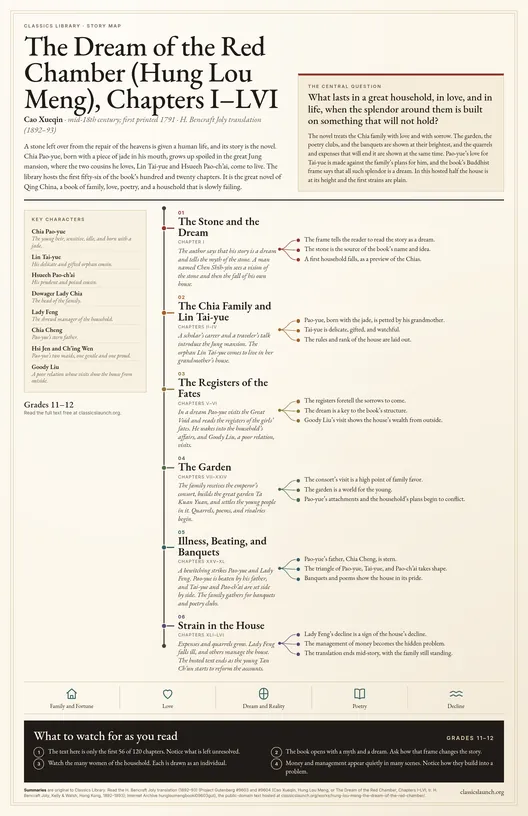 Story mapSee the story mapThe whole book on one page: the story in movements, the characters, and what to watch for. Free to print.
Abstract
Background. Written by a member of a once great family that had fallen, the book draws on its author's memory of lost wealth. It was copied by hand for years and is now counted as the greatest of China's novels.
Plot. A boy raised among women in a mighty house, with two cousins who are his friends and rivals for his heart, lives through feasts, quarrels and illnesses, while the family spends beyond its means.
Structure. Each chapter has a heading in paired lines, a narration of daily events and a good deal of verse. Joly's version covers only the first third of the whole.
Themes. The book dwells on the passing of beauty and wealth, the order of the household, the love of the young and the claims of duty. Its sense of the world is Buddhist and Taoist, and it invites comparison with the Preacher of Ecclesiastes, who says that all is vanity and then tells his reader to fear God.
Significance. This is the best known novel in the Chinese language and has shaped its literature and culture. The partial translation is a historic first step towards giving the book to English readers.
Main characters
- Chia Pao-yue: Boy of the family born with a jade in his mouth
- Lin Tai-yue: Delicate orphan cousin who loves him
- Hsueeh Pao-ch'ai: Prudent cousin who is her rival
- Dowager lady Chia: Head of the family
- Lady Feng: The household's brilliant manager
Summary
The Dream of the Red Chamber is the great novel of Qing China, and this hosted text is a partial one: the first fifty-six chapters of a work that runs to a hundred and twenty, as rendered into English by H. Bencraft Joly in 1892 and 1893. The book opens with a myth. A stone left over from the Empress Nue Wo's repair of the heavens (so Joly spells the name) is given a human life and set down in the world, and its story, written upon its own surface, is what the novel claims to be. The human story that follows is that of the Chia family, whose two branches live in the Ning and Jung mansions of the capital, grand houses sustained by imperial favour. The centre of the tale is a boy, Chia Pao-yue, born with a piece of jade in his mouth, who is petted by the dowager lady Chia, the head of the family, and who is sensitive, idle and fond of the girls of the household more than of the books his father wants him to read. His cousin Lin Tai-yue, a delicate and gifted orphan, comes to live in the house, and so does Hsueeh Pao-ch'ai, a poised and prudent cousin, and the three are drawn together in a triangle of affection which the family will have to settle. Around them is a crowd of aunts, cousins, servants and clients: the shrewd manager lady Feng, who runs the household, the servant Hsi Jen, the proud maid Ch'ing Wen, the poor relation goody Liu and many others. Within the first chapters a dream of Pao-yue shows him the registers of the women's fates in the Great Void, and the sorrow that waits under the family's splendour. The chapters here describe a great visit by the emperor's consort, the building of a pleasure garden, poetry gatherings and feasts, a quarrel, a beating, a bewitching and a long run of small events. The warnings are plain: money and honour pass, and the house is spending more than it has. Joly's translation breaks off in the middle of the story. Its main interest for a school library is as a window on a Chinese household of the eighteenth century, and as a long study of family duty, desire and the passing of earthly things, which a Christian reader may set beside the preacher's words that all is vanity.
Virtues in this work
- Piety: The household is held together by a sense of reverence for parents and ancestors, though the novel shows how thin that reverence can become.
- Prudence: Pao-ch'ai and, at times, lady Feng act with judgment where others are carried away; the novel also shows what follows when a family does not count its costs.
- Temperance: The passing nature of pleasure and rank is the theme of the opening, and the plot shows excess giving way to want.
- Humility: The author's opening confession of his own failings sets the book's tone of repentance and clear sight.
Plot or Argument
- The stone and the dream (Chapter I)
The author explains that his story is a dream, tells the myth of the stone, and shows Chen Shih-yin's vision of a stone and of the fall of his house.
- The Chia family and Lin Tai-yue (Chapters II–IV)
Chia Yue-ts'un's career and Leng Tzu-hsing's account of the Jung mansion lead to the arrival of the orphan Lin Tai-yue in her grandmother's house.
- Pao-yue's dream of the registers (Chapters V–VI)
Pao-yue visits the Great Void in a dream, sees the book of the fates of the girls, and wakes into the household's affairs; goody Liu visits the mansion.
- The great house and the garden (Chapters VII–XXIV)
The Chia family receives the emperor's consort, builds the Ta Kuan Yuan garden, and settles the young people in it, with quarrels, poems and the first stirrings of rivalry.
- Fortune, illness and ceremony (Chapters XXV–XL)
A bewitching strikes Pao-yue and lady Feng, Pao-yue is beaten by his father, Tai-yue and Pao-ch'ai are set side by side, and the family gathers for banquets and poetry clubs.
- The household managed and strained (Chapters XLI–LVI)
The family's expenses and quarrels grow, lady Feng's illness shifts the management to others, and the translation ends as the young Tan Ch'un begins to reform the household accounts. Lady Feng's miscarriage and decline appear in Chapter LV.
Characters
- Chia Pao-yue, the young heir
A gifted and gentle youth, favourite of his grandmother, who dislikes the examinations and loves the company of the women of the house.
- Lin Tai-yue, the delicate cousin
An orphan of fine mind and sharp tongue who comes to live in the Jung mansion and loves Pao-yue.
- Hsueeh Pao-ch'ai, the prudent cousin
A handsome and steady young woman, learned and discreet, who stays at the mansion with her mother and brother.
- Dowager lady Chia, head of the family
The venerable matriarch, who dotes on Pao-yue and presides at the family's feasts.
- Lady Feng (Wang Hsi-feng), household manager
A clever, ruthless and charming young matron who runs the Jung mansion's affairs.
- Chia Cheng, Pao-yue's father
A stern and upright official who wishes his son to take the road of study and office.
- Hsi Jen and Ch'ing Wen, Pao-yue's maids
Two serving girls in his rooms, the one devoted and cautious, the other quick and proud.
- Goody Liu, a poor relation
A country woman who visits the great house and gives the novel some of its comic scenes.
Lessons
The vanity of earthly splendour
The novel opens with a warning that wealth, rank and beauty pass like a dream, and the Chia family spends its fortune as though it would last for ever. A Christian reader will hear in this an echo of the preacher's words in Ecclesiastes, that all is vanity, though the novel's answer is Buddhist and Taoist renunciation and not hope in God.
- Where does the novel say that the family's splendour will not last?
- How does the Christian answer to vanity differ from the answer the novel gives?
Family duty and filial piety
The household is held together by a strict order of respect, from the dowager to the youngest servant, and by the duty of children to their parents. Students can compare this with the fifth commandment and with the Confucian emphasis on filial piety, and ask where each is strong or weak.
- How does Pao-yue relate to his father and to his grandmother?
- What does the book say about children who forget their parents?
The education of the young
Chia Cheng wishes Pao-yue to study for the examinations, and Pao-yue prefers poems and the company of the girls. The conflict raises the question of what education is for and who shall direct it, which the classical tradition answers with the formation of virtue.
- What does Chia Cheng want for his son, and why?
- What does Pao-yue need to learn that he does not?
A reader's caution on desire and the household
The novel records adolescent love and a few scenes of desire in the household's life, with the household servants who are bound to the family's will. Teachers should read the chapters with the oldest students and ask them to judge these things by Christian teaching on chastity and on the dignity of the servant.
- How does the novel show the position of the maids and servants?
- What does Scripture ask of masters and of those who serve?
Context
The novel is set in a great mandarin family of the Qing dynasty in the eighteenth century, in a capital city, in the age of the Kangxi and Qianlong emperors. The Chia family holds its place through imperial favour and the career of its sons, and its fortune is bound to the emperor's good will.
Composition
Cao Xueqin wrote the novel in the middle of the eighteenth century and revised it over many years, and it circulated in manuscript copies until the first printed edition of 1791, in 120 chapters, completed by other hands. The Joly translation of 1892 and 1893 renders the first fifty-six chapters from the Chinese and was published in two volumes at Hong Kong.
Reception
The book is regarded in China as the greatest of its novels, and a whole field of study, Redology, has grown up around it. Joly's version was one of the first English attempts, and later translators have given the whole novel in English, but the Joly text is in the public domain and is the one hosted here.
Comparisons
- The Tale of Genji (the first seventeen chapters)
The Tale of Genji is another long court novel of love and the passing of splendour, from Japan seven centuries earlier, and the two works share a Buddhist sense of the transience of beauty.
- Journey to the West (A Mission to Heaven)
Another Chinese classic that opens with a stone and mixes myth with satire, though its pilgrim quest is a different kind of book from the household chronicle of the Chia family.
- The Analects
Confucian teaching on the family, filial duty and the education of the young gives the moral order which the Chia household both keeps and breaks.
- Tao Te Ching
The Taoist priest and the Buddhist monk of the opening chapter bring in the Taoist sense that wealth and honour are a passing show.
- The Pilgrim's Progress
Bunyan's allegory is also told as a dream, in which a man is warned that the city of this world passes, and it gives a Christian counterpart to the lessons of Pao-yue's dream.
- Anna Karenina
Tolstoy's novel of a great family, its marriages and its changing fortunes, is a useful companion for the study of household and passion in a very different world.
Quotes
Frequently cited
“When falsehood stands for truth, truth likewise becomes false,”
Frequently cited
“Where naught be made to aught, aught changes into naught.”
Frequently cited
“but these dreams constitute the main argument of this work, and combine, furthermore, the design of giving a word of warning to my readers.”
“I suddenly bethought myself of the womankind of past ages.”
“the reckless waste of half my lifetime”
“Like scattering clouds doth fleet a vernal dream;”
“In useless grief what profit will ye find?”
“But filial sons and grandsons who have seen?”
For Students
A reading companion for classical Christian high school students. See the student guide.
Reading Guide
Watch for
- How the first chapter frames the story as a dream and a stone's record.
- The dream of the Great Void in Chapter V and what it shows Pao-yue.
- How lady Feng manages the household, and what her management costs her.
- The family's feasts, poems and ceremonies, and what they say about its values.
- Each sign in the early chapters that the house is spending more than it has.
Key terms and names
- The Jung and Ning mansions
- The two great houses of the Chia family in the capital, the one the home of Pao-yue and the other of the elder branch.
- The Great Void
- A visionary region in Pao-yue's dream where the fates of the women of the family are written in registers.
- Filial piety
- The Confucian duty of a child to honour and obey parents and ancestors.
- The jade
- The piece of jade that Pao-yue is said to have been born with in his mouth, a token of his fate.
- Bonze
- A Buddhist monk, as Joly calls the holy men who appear in the opening chapter.
- The garden (Ta Kuan Yuan)
- The pleasure garden built for the emperor's consort and afterward the home of the young people.
Seminar Questions
- Comprehension Who is Chia Pao-yue, and what is peculiar about his birth?
- Comprehension How does the family receive Lin Tai-yue, and what is her position in the house?
- Comprehension What does Pao-yue see in his dream of the Great Void?
- Interpretation Why does the author say that his story is a dream, and what does he mean by saying that falsehood and truth change places?
- Interpretation How does lady Feng manage the household, and what do her methods show about her?
- Interpretation What do the feasts and the poetry gatherings tell us about the family's values?
- Big Question If earthly splendour is a dream, how should a person live in it? Answer from the novel and from Ecclesiastes.
- Big Question What does a household owe to its children, and what do children owe to a household?
Faith Connections
- Ecclesiastes 1:2-11 (Scripture)
The preacher's words that all is vanity set a biblical answer beside the novel's dream-teaching on the passing of wealth and beauty.
- Exodus 20:12 (Scripture)
The command to honour father and mother is the Christian counterpart to the filial piety that governs the household.
- Matthew 6:19-21 (Scripture)
Christ's warning against treasure on earth, where moth and rust corrupt, bears on the Chia family's spending of its fortune.
- Augustine, City of God, Book 1 (Church Fathers)
Augustine's reflection on the fall of great earthly cities and on the hope that lies beyond them gives a Christian comparison for the fall of the Chia house.
Logic and Rhetoric
Central argument: Splendour, wealth and beauty pass like a dream, and a family that spends them without thought for what endures will see them go; the wise person looks beyond the dream.
Rhetorical device: framing allegory. The opening myth of the stone and the dream of Chen Shih-yin frame the whole novel as a story that is partly false and partly true, and invite the reader to find the truth beneath the fiction.
Debate: Resolved: That the Chia family is ruined by its own conduct and not by fortune.
Memory Work
When falsehood stands for truth, truth likewise becomes false,
In useless grief what profit will ye find?
Writing Prompts
Essay: Using at least three passages, explain how the opening chapter frames the novel as a dream and say what lesson the author intends.
Comparison with The Tale of Genji (the first seventeen chapters): Compare the picture of a court or great household in the two novels, and say how each shows the passing of splendour.
Medical Lens
Chinese household medicine is part of the fabric of the novel. Physicians are called to the sick, ginseng and other tonic pills are taken, and diagnosis rests on the pulse and on the balance of the body. Lin Tai-yue's delicate health and her fear of consumption run through the early chapters, and in Chapter XXV Pao-yue and lady Feng are struck by a sudden fever and delirium which the household attributes to witchcraft. The novel is a rich literary source for the domestic practice of traditional Chinese medicine in the eighteenth century, though it is not a medical text.
- Chapter III
Tai-yue's weak constitution is noted on her arrival, and the household asks what medicines she takes.
- Chapter XXV
Pao-yue and lady Feng are struck down with madness and fever, which the household treats as an enchantment.
- Chapter XXXII
Tai-yue speaks of the doctors' fear that consumption will declare itself.
- Chapter LV
Lady Feng suffers a miscarriage after overwork and is attended by several doctors.
Creative Prompts
- Essay
Read the opening chapter and write an essay on how the author uses the idea of a dream to frame his story, and on what the dream is meant to teach.
- Dialogue
Write a dialogue between Chia Cheng and Pao-yue in which father and son each explain what a good education is.
- Classroom
Draw a map of the Chia household from the dowager lady to the youngest maid, and use it to explain how authority works in the family.
- Poetry
Write a short poem or a lament in the manner of the girl's song in Chapter I on the passing of beauty, and add a Christian answer to it.
Further Reading
- The Story of the Stone (The Dream of the Red Chamber), Cao Xueqin, tr. David Hawkes and John Minford
The standard modern English translation in five volumes, which carries the story to the end.
- The Tale of Genji, Murasaki Shikibu
A companion court novel in this library.
- Tales of the Chinese novel (introduction to the Story of the Stone), David Hawkes
Hawkes's long introduction to the first volume of his translation, on the author, the manuscripts and the book's themes.
Verification notes
The text is H. Bencraft Joly's English translation of the first fifty-six chapters (Hong Kong: Kelly & Walsh, 1892–1893), taken from Project Gutenberg #9603 and #9604 (the Gutenberg license text, errata and transcriber notes are removed, and underscores marking italics are removed). The work is partial: the original novel has 120 chapters, and Joly published only the first two books. Names follow Joly's Wade-Giles spellings, which differ from modern pinyin. Every quotation in this file was matched to the hosted text. The author's dates, the date of the first printed edition and the attribution of the last forty chapters follow standard reference works.
- Cao Xueqin's dates (c. 1715–1763) are uncertain and follow standard reference works.
- The date of the first printed 120-chapter edition (1791) and the attribution of the last forty chapters to Gao E follow standard reference works.
- The Ta Kuan Yuan garden is rendered by Joly as the garden of Broad Vista; the name should be checked against the text before it is used in a lesson.
- Joly's rendering of some names and poems is dated and sometimes odd; teachers should check names against a modern translation.
- The further-reading entry on Hawkes's introduction is cited from memory (the exact title of the introduction should be checked).
- The assignment of events to chapters follows the chapter headings in the hosted text and should be checked against the page before use.