Work record
The Tale of Genji (the first seventeen chapters)
Murasaki ShikibuGenji Monogatari; The Tale of Genji (Suematsu); Genji Monogatari (Suyematz); The Story of GenjiThe Tale of Genji (the first seventeen chapters) by Murasaki Shikibu (c. 1000–1012)The Tale of Genji is a long prose fiction written about the year 1000 by a Japanese court lady, Murasaki Shikibu, and it is often called the first novel.Also known as: Genji Monogatari · The Tale of Genji (Suematsu) · Genji Monogatari (Suyematz) · The Story of Genji
c. 1000–1012 · Medieval · Novel · Japanese
Read this when you want to enter a vanished court and weigh beauty against desire's harm.
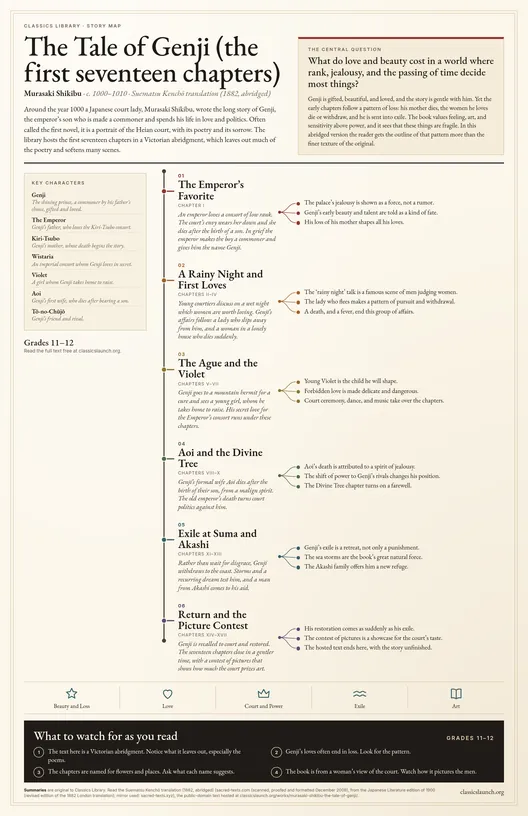 Story mapSee the story mapThe whole book on one page: the story in movements, the characters, and what to watch for. Free to print.
Abstract
Background. A lady of the Japanese court wrote this long story about the year 1000, and Japanese readers have treasured it ever since. The first English version, by a Japanese student in London in 1882, shortened the book and covered only seventeen chapters.
Plot. A prince born to a favourite consort is made a commoner and grows up to be a famed lover. He mourns his mother, loses several women he loves, takes a young girl into his house, and goes into exile on a stormy coast before the court recalls him.
Ideas. The tale asks how a refined world should answer the passing of all things. It praises beauty and loyalty, shows the harm that desire does to women, and keeps in view the Buddhist teaching that nothing lasts.
Text. The hosted text is the 1882 abridgment, with the translator's introduction. Students should read it with a teacher, because it involves adultery and the care of a young ward, and should use the guide to prepare for discussion of a culture foreign to the gospel. Teachers can pair this work with the library's study guide, seminar questions and memory-work selection to prepare a discussion, a short essay or a recitation. The full text is hosted on this site, and each quotation in the guide has been checked against the hosted text.
Main characters
- Genji: The Emperor's son, made a commoner
- Kiri-Tsubo: His mother, a consort who dies young
- Violet: The girl he raises in his house
- Wistaria: An imperial consort whom Genji loves
- Aoi: His wife, who dies after childbirth
- Tô-no-Chiûjiô: His friend and rival
Summary
The Tale of Genji is a long prose fiction written about the year 1000 by a Japanese court lady, Murasaki Shikibu, and it is often called the first novel. The library hosts the opening seventeen chapters in the abridged English version of Suematsu Kenchō, published in London in 1882. This was the first translation of any part of the book into English, and it is a Victorian paraphrase rather than a faithful rendering. It leaves out much of the poetry and softens many scenes, and the student should read it as a door into the work and not as the whole of it. The story begins in the palace of an unnamed Emperor, who loves a consort of low rank, the lady of the Kiri-Tsubo chamber. The jealousy of the other ladies wears her down, and she dies soon after bearing him a son. The boy is brilliant and beautiful, and because he has no strong family behind him the Emperor makes him a commoner, with the name Genji. The next chapters follow Genji's youth. A rainy-night conversation among young courtiers about the kinds of women worth loving leads to a string of love affairs, some careless and some tender, with ladies of different ranks. One of these ends in a lonely house with the sudden death of a woman he has hidden away, and Genji falls ill with grief and fever. On a journey to a mountain hermit to be cured of ague, Genji finds a little girl, called Violet in this translation, and takes her into his own house to raise her. He also pursues a forbidden attachment to Wistaria, a consort of the Emperor. His marriage to Aoi, the daughter of a great minister, is cold, and she dies after the birth of their son, which the book explains as a spirit's work. When his enemies at court gain power, Genji chooses exile, first at Suma and then at Akashi, where storms and dreams shake him. He is recalled, and the seventeen chapters end with a gentler court and a contest of pictures. The tale shows a refined world that prizes beauty, poems, perfume and manners, and it is honest about what that world costs, in the loneliness of women, the decay of a court and the unhappiness that follows reckless desire. It rests on Buddhist ideas of the passing of all things. A classical Christian reader will find it a rich picture of a culture without the gospel, and will need to read it with a teacher, because many scenes involve adultery, seduction and the guardianship of a girl who grows up in the household of the man who later loves her.
Virtues in this work
- Prudence: The tale shows how reckless choices bring grief, and some characters learn to weigh their acts.
- Temperance: The unhappy consequences of Genji's desires show the need for self-command.
- Fortitude: Genji bears exile, and Kiri-Tsubo endures the cruelty of the court without complaint.
- Charity: The Emperor's care for his motherless son and Genji's care for Violet show kindness in a hard world.
Plot or Argument
- The Kiri-Tsubo chamber (Chapter I)
An Emperor's love for a consort of low birth stirs the envy of the court. She falls ill under the strain and dies soon after the birth of a son, and the Emperor, in grief, makes the boy a commoner named Genji.
- The rainy night and first loves (Chapters II to IV)
Young courtiers talk through a wet night about the kinds of women worth loving. Genji's affairs follow, with a lady who slips away from him, and with a woman of a lonely house who dies suddenly, after which he is ill with fever for days.
- Ague, Violet and Wistaria (Chapters V to VII)
Genji visits a hermit on a mountain to be cured of ague and finds a girl whom he takes home to raise. His secret passion for Wistaria, the Emperor's consort, runs through these chapters.
- Aoi and the Divine Tree (Chapters IX and X)
Aoi, Genji's formal wife, dies after the birth of their son, from what the text calls a malign spiritual influence. Court politics turn against Genji as the old Emperor dies.
- Exile at Suma and Akashi (Chapters XII and XIII)
Rather than wait for disgrace Genji withdraws to the coast. Storms and a recurring dream test him, and a man from Akashi comes to his aid.
- Return and the show of pictures (Chapters XIV to XVII)
Genji is recalled and restored. The seventeen chapters close with the court at a gentler time, and with a contest of pictures that shows how much the court prizes art.
Characters
- Genji, hero
The emperor's son, made a commoner for his own safety, who is admired for his beauty and gifts and whose desires bring both delight and grief to many.
- Kiri-Tsubo, Genji's mother
A consort of low rank whom the Emperor loves above the rest and whom the jealousy of the court destroys.
- The Emperor, Genji's father
A kind and troubled ruler who cannot protect the woman he loves and who looks after her son.
- Wistaria, imperial consort
A lady of the palace who resembles Genji's lost mother and who becomes the object of his forbidden love.
- Violet, Genji's ward
A girl whom Genji takes from a mountain village and raises in his own house, and who later becomes his closest companion.
- Aoi, Genji's wife
The proud daughter of a great minister who is married to Genji and who dies after the birth of their son.
- Tô-no-Chiûjiô, friend and rival
Aoi's brother, Genji's friend and companion in love and in rivalry at court.
Lessons
Beauty and its cost
The tale loves poetry, gardens, robes and music, and it shows that a world given to beauty can neglect justice and the care of the weak. Students can compare the court's refinement with the biblical call to love mercy as well as beauty.
- Which scenes show real kindness and which show only polish?
- What does the court lose by prizing form so highly?
Desire without law
Genji's affairs bring joy to himself and grief to others, including a dead woman, an abandoned lady and a woman he may not love. The book does not always condemn him, and the reader can notice where it does show the cost. A teacher can set these scenes beside Proverbs 5 and James 1:14-15.
- Who is hurt by Genji's choices?
- Where does the text show regret, and where does it excuse him?
Women in a court of concubines
Most women in the tale live at the mercy of men's visits, family politics and rank. Murasaki Shikibu writes with sympathy for their loneliness. Students can discuss marriage as God designed it, and why the book's world falls short of it.
- How do the women in the chapters speak of their own lives?
- What does the tale show about the loneliness of a woman who waits?
Impermanence and the search for rest
The tale is steeped in the Buddhist teaching that all things pass. A Christian reader can respect the honesty of that sorrow and still answer it with the hope of the resurrection, as the book of Ecclesiastes asks for a hope above the sun.
- How does the book treat death and grief?
- What answer does it give, and what answer would a Christian give?
Context
The tale is set in the Heian court at Kyoto, the capital of Japan from 794, when a few great families, above all the Fujiwara, ruled through marriages with the imperial house. Court life centred on rank, poetry, calligraphy, music and the arrangement of seasonal ceremonies, and men of high rank kept many wives and concubines. Buddhism shaped how people understood death, illness and the unseen, and priests and hermits were called on for exorcisms and cures.
Composition
The author wrote at court about the years 1000 to 1012, for readers among the ladies and gentlemen of the palace. The Suematsu translation, made when he was a student in England, was published in London in 1882, and an American edition followed in 1900. It covers only the first seventeen of the fifty-four chapters, and it abridges them.
Reception
The Tale of Genji has been read in Japan for a thousand years, and the greater part of Japanese literature after it answers it. In English the Suematsu version was soon replaced by the full translation of Arthur Waley (1925 to 1933), which made the tale known to a wide audience.
Comparisons
- The Pillow-Book of Sei Shōnagon
Sei Shōnagon served at the same court a few years earlier and wrote a witty notebook of her tastes; the two women's books are the great pair of Heian prose.
- Essays in Idleness (Tsurezuregusa)
Kenkō looks back on the court from a Buddhist hermit's view and shows what its refinement became in an age of war.
- The Princess of Cleves
The French novel of 1678 also studies love and duty in a court, and the pair makes a good contrast between two courts' understanding of desire.
- Kokoro
Sōseki's Kokoro, in this library as a guide, carries the questions of love, guilt and the self into modern Japan.
- The Canterbury Tales
Chaucer's tales give a medieval English portrait of love, marriage and religion, which may be set against the court of Heian Japan.
Quotes
Frequently cited
“In the reign of a certain Emperor, whose name is unknown to us, there was, among the Niogo and Kôyi 2 of the Imperial Court, one who, though she was not of high birth, enjoyed the full tide of Royal favor. Hence her superiors, each one of whom had always been thinking—"I shall be the one," gazed upon her disdainfully with malignant eyes, and her equals and inferiors were more indignant still.”
Frequently cited
“It was the time when Genji became subject to periodical attacks of ague, that many exorcisms and spells were performed to effect a cure, but all in vain. At length he was told by a friend that in a certain temple on the northern mountain (Mount Kurama) there dwelt a famous ascetic, and that when the epidemic had prevailed during the previous summer, many people had recovered through his exorcisms. "If," added the friend, "the disease is neglected it becomes serious; try therefore, this method of procuring relief at once, and before it is too late.”
“Such being the state of affairs, the anxiety which she had to endure was great and constant, and this was probably the reason why her health was at last so much affected, that she was often compelled to absent herself from Court, and to retire to the residence of her mother.”
“at last she passed away, worn out, as it were, with care. When I think of the matter in that light, the kindest favors seem to me fraught with misfortune.”
“And how much more then are those women undeserving of our admiration, who though they are rich in outward and in fashionable display, attempting to dazzle our eyes, are yet lacking in the solid foundations of reality, fidelity, and truth!”
“And these thoughts affected him so deeply that he became ill, his head ached, his pulse beat high, and his body burned with fever.”
“I have long since quitted the affairs of this world, and have almost forgotten the secret of my exorcisms.”
“Thus the modest and virtuous Lady Aoi passed away forever.”
“Genji at last made up his mind to undergo a voluntary exile, before the opinion of the Imperial Court should be publicly announced against him.”
“It was written by a lady, who, from her writings, is considered one of the most talented women that Japan has ever produced.”
For Students
A reading companion for classical Christian high school students. See the student guide.
Reading Guide
Watch for
- The way the court speaks of rank, and what it costs those of low rank.
- Each place where illness, grief or a spirit is named as a cause of suffering.
- The seasons, the poems and the gifts, and what they say about the court's values.
- Moments where Genji's desire hurts someone and the narrator says so.
Key terms and names
- Niogo and Kôyi
- Court titles for imperial consorts of the lower ranks, such as the lady of the Kiri-Tsubo chamber.
- Sadaijin
- The Minister of the Left, a great officer of state; Aoi's father holds this title in the translation.
- Ague
- The word the translator uses for a recurring fever, with chills, treated in the story by a hermit's exorcism.
- Exorcism
- A rite by which a priest or hermit tries to drive out a dangerous spirit that is thought to cause illness.
- Heian
- The period from 794 to about 1185 in which the court at Kyoto ruled, and in which the tale is set.
Seminar Questions
- Comprehension How does the Emperor treat Kiri-Tsubo, and what happens to her?
- Comprehension What does Genji discover on the mountain, and why does he go there?
- Interpretation Why does the tale describe Aoi's death as the work of a spirit?
- Interpretation How does the narrator judge Genji's love affairs?
- Interpretation What does the court's love of poetry and seasons show about what it values?
- Big Question Can a culture that prizes beauty above all be just to the weak?
- Big Question What is the difference between the sorrow of the passing of things in this tale and the Christian understanding of death?
Faith Connections
- Proverbs 5 (Scripture)
The warning against the adulteress and the call to rejoice in the wife of one's youth stand in sharp contrast to the court's practice, and the chapter shows the cost of unlawful desire.
- Ecclesiastes 1 (Scripture)
The Preacher's cry that all is vanity echoes the tale's sense of passing things, and his answer lies beyond the sun.
- Augustine, Confessions, Book II (Great Conversation)
Augustine's account of the pleasures of youth and the restlessness that followed them gives a Christian reading of what the tale shows.
Logic and Rhetoric
Central argument: A court that lives for beauty and desire gains great refinement, but it cannot protect its weak, and the sorrow of passing things shows its need for a lasting hope.
Rhetorical device: frame of impermanence. Scenes of joy are shadowed by the death of a favoured lady, the grief of the Emperor and the fall of a prince, so that delight is always shown against loss.
Debate: Resolved: That the court of The Tale of Genji is more to be admired than to be pitied.
Memory Work
In the reign of a certain Emperor, whose name is unknown to us, there was, among the Niogo and Kôyi 2 of the Imperial Court, one who, though she was not of high birth, enjoyed the full tide of Royal favor. Hence her superiors, each one of whom had always been thinking—"I shall be the one," gazed upon her disdainfully with malignant eyes, and her equals and inferiors were more indignant still.
Thus the modest and virtuous Lady Aoi passed away forever.
Writing Prompts
Essay: Explain how the first chapter of the tale sets up a world in which love and ruin are close together.
Comparison with The Pillow-Book of Sei Shōnagon: Compare how Murasaki Shikibu and Sei Shōnagon write about the same court, and say what each shows that the other leaves out.
Medical Lens
The text shows how a Heian household understood illness: ague and fever as matters for priests and exorcists, a woman's death in childbirth as a spirit's attack, and grief as a cause of bodily sickness. It is a source for the history of medicine and religion in Japan, and it should not be read as medical advice.
- Chapter IV
After a woman's sudden death, Genji's grief shows itself in headache, rapid pulse and fever, and his household serves him rice gruel.
- Chapter V
Genji suffers periodic attacks of ague, and his friends advise him to visit a mountain hermit for exorcisms, a cure used in the epidemic of the previous summer.
- Chapter IX
Aoi's death after childbirth is ascribed to a malign spiritual influence, and her body is left untouched for days in the hope that she may revive.
- Chapter I
Kiri-Tsubo's frail health is linked to the anxiety of court jealousy.
Creative Prompts
- Essay
Choose one scene in the seventeen chapters and explain what the court values and what it overlooks, using only what the translation says.
- Classroom
Divide the class into those who read Genji as a man who loves and those who read him as a man who takes; ask each side to use scenes from Chapters II to V.
- Poetry
Write a short poem in the manner of the court, with a seasonal image and a feeling of parting, and explain why the court prized such verses.
- Dialogue
Write a conversation between Kiri-Tsubo's mother and a court lady about whether the Emperor's love was a blessing or a curse.
Further Reading
- The Tale of Genji, Murasaki Shikibu, trans. Arthur Waley
The classic full English version in six volumes (1925 to 1933), now widely reprinted; use a recent paperback with notes.
- The Pillow-Book of Sei Shōnagon, Sei Shōnagon
The notebook of a rival court lady, in this library.
- Essays in Idleness, Kenkō
A fourteenth-century priest's view of the same court's later world, in this library.
Verification notes
The hosted text is the abridged English version of Suematsu Kenchō (1882) as given on sacred-texts.com from the 1900 Japanese Literature edition; the library hosts the first seventeen chapters, the translator's introduction and his notes. Footnote markers were removed from the body, and three stray markers may remain. The translation paraphrases and shortens the original, and it uses names such as Violet, Wistaria and Cicada for characters whom modern translations call Murasaki, Fujitsubo and Utsusemi. The translator's introduction gives 992 as the year of the author's death, which modern scholars no longer accept. Dates of the author's life are approximate. All quotations were checked against the hosted text.
- The author's dates, which scholars give only approximately.
- The chapter-by-chapter identification of characters between Suematsu's names and those used in modern translations.
- Whether a few stray footnote markers remain in the hosted text.